
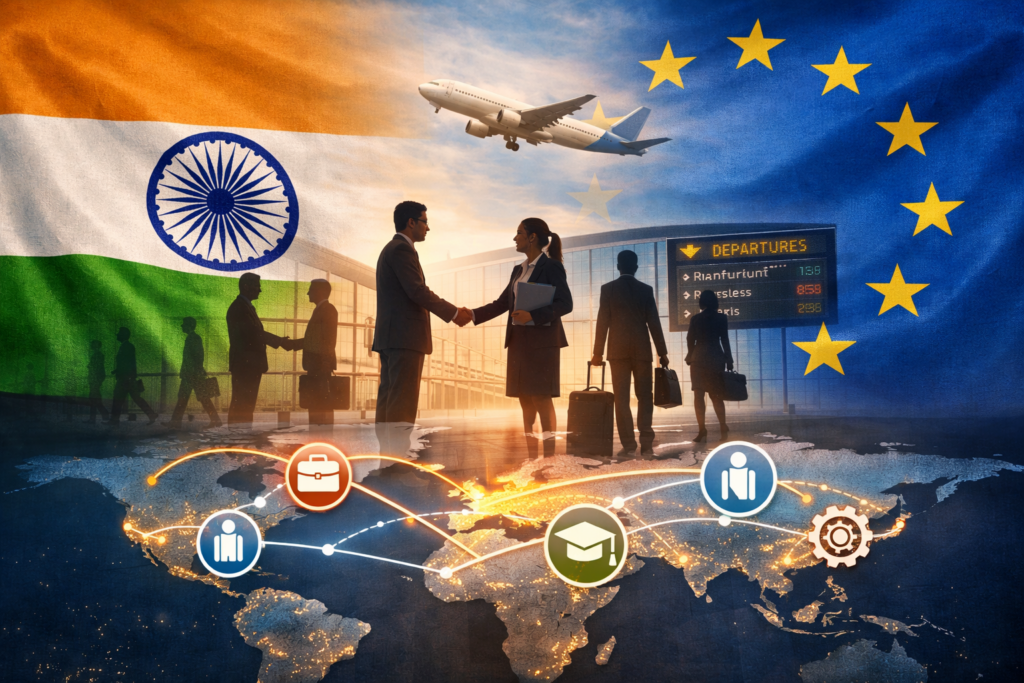
In late January 2026, India and the European Union announced the conclusion of a long-awaited free trade agreement (FTA), alongside related cooperation intended to deepen services trade and ease movement of people linked to cross-border business. This matters for global mobility because India–Europe trade is unusually services-heavy, and services scale fastest when firms can move people—quickly, predictably, and at reasonable compliance cost.
1) Mobility moves from “nice-to-have” to a negotiated deliverable
The most direct mobility signal in the package is that it treats temporary entry of service providers as part of the commercial bargain, not a side issue. The EU’s chapter-by-chapter summary explicitly flags “provisions on mobility of professionals” as among the most ambitious commitments either side has made in past agreements.
India’s official factsheet goes further and lists specific categories the deal is designed to cover—Business Visitors, Intra-Corporate Transferees, Contractual Service Suppliers, and Independent Professionals—framed as an “assured regime for temporary entry and stay.”
Why that’s a big deal: those categories map closely to the real-world pathways used by tech, engineering, consulting, finance, education, and project delivery teams. In other words, the agreement is aimed at reducing friction in the exact corridors where India–EU commerce is growing fastest.
2) A predictable “services mobility stack” for firms
If implemented as described in the factsheet, the agreement creates a more structured operating environment for cross-border staffing:
- Intra-company movement with family considerations. The factsheet indicates eased movement of employees (and “spouses and dependents”) of Indian corporates established in the EU across services sectors.
- Contract-based delivery with clearer coverage. It references access across 37 sub-sectors for supplying services under contract to EU clients, and 17 sub-sectors for independent professionals (including areas like IT, R&D, higher education).
- Students and post-study work as part of the economic link. It describes a “continuing conducive framework” for Indian students to enter, study, and access post-study work visas.
- Social security coordination as a competitiveness lever. A stated goal is enabling Social Security Agreements with EU Member States within five years—important because “double contributions” and portability issues can be a hidden mobility tax.
Taken together, this is a pragmatic recipe: smoother short-term entry for projects + clearer lanes for longer services assignments + a talent pipeline via students.
3) Professional recognition becomes a mobility accelerator
A recurring bottleneck in global mobility is not the visa itself, but whether a person can legally perform regulated work once they arrive. Some reporting around the deal highlights mutual recognition dialogue for professional qualifications (e.g., accounting/architecture/medical areas), which—if it becomes operational—would reduce the need for case-by-case “local equivalency” workarounds.
Mobility impact: fewer “credential cliffs” means faster deployments, more cross-border consulting revenue, and less pressure to rely on non-regulated roles or subcontracting structures.
4) The biggest winners: four mobile cohorts
- Project teams in tech, engineering, and consulting
These teams depend on short notice travel, multi-country assignments, and client-site presence. Clearer temporary entry categories and contract supplier lanes are designed for exactly this. - Indian and EU multinationals doing “follow-the-client” delivery
Intra-company transferee channels (and dependent/family recognition) reduce churn costs and make Europe postings more attractive relative to other regions. - Students and early-career movers
By explicitly tying study pathways to post-study work options, the agreement helps convert education flows into skills flows—often the most durable form of migration corridor. - EU employers facing skill shortages
Europe’s long-run demographic pressures make skilled mobility politically sensitive but economically valuable. A trade-linked mobility package can be easier to sell domestically as “targeted, rules-based, and reciprocal.”
5) Second-order effects beyond India and Europe
- Competition with other “talent magnets.” If Europe becomes administratively easier for Indian professionals and students, it competes more directly with the US, UK, Canada, Australia, and Gulf hubs on friction and predictability.
- Rebalancing global delivery footprints. Firms may shift some delivery and regional HQ decisions toward EU locations if staffing becomes more reliable—especially for regulated industries and public-sector contracts.
- Standard-setting spillovers. Once a large corridor formalises mobility categories, it tends to influence how later FTAs define “who can move, for what, and for how long,” shaping global norms.
6) The fine print that will decide whether mobility actually improves
Trade deals can promise smoother movement, but outcomes hinge on implementation. Three “watch items” stand out:
- Ratification and timeline risk. Reporting suggests ratification could take around a year, and real mobility changes may phase in unevenly by Member State.
- Member State variability. Even with an FTA, work authorisation and salary thresholds can differ substantially across EU countries; companies will still need country-specific playbooks.
- Compliance and politics. Mobility chapters are politically fragile; enforcement, safeguards, and public sentiment can affect how generously pathways are administered in practice.
7) What this means in practice for globally mobile professionals
If you’re advising clients (or planning your own move), the near-term practical shift is more routes with clearer labels—business visitor vs contractual supplier vs intra-company transferee—plus a stronger policy intent to connect study → work → longer-term skills circulation.
The medium-term prize is bigger: if social security coordination and professional recognition mechanisms become functional, mobility costs drop structurally—not just administratively.